Mt Pirongia - Land, History, People
MĀORI HISTORY AND TRADITION
The waka Tainui, commanded by Hoturoa, landed on the east coast of the North Island after a long, hazardous voyage from the Pacific. They followed the coast up to the Waitemata Harbour where sea birds were seen to the west.
Hoturoa instructed that the waka be carried across the land and so they reached the Manukau Harbour. From there they sailed south towards Mount Karioi and landed at Aotea Harbour. After a further journey to Mokau they returned to Kawhia.
The earliest settlements of the Waikato centered on the harbours of Kawhia, Aotea and Whāingaroa (Raglan) with their rich supplies of seafood. As the populations grew, people moved eastward over and around Pirongia and into the Waipa.
Here settlement focused around wetlands, rich in resources: foods like freshwater mussels, eels and waterfowl; and building materials like raupo and manuka.
Food was also taken from Pirongia, mainly forest birds, berries and edible plants.
Both Karioi and Pirongia are said to have gained their names from Raka-taura, the Tainui tohunga (high priest).
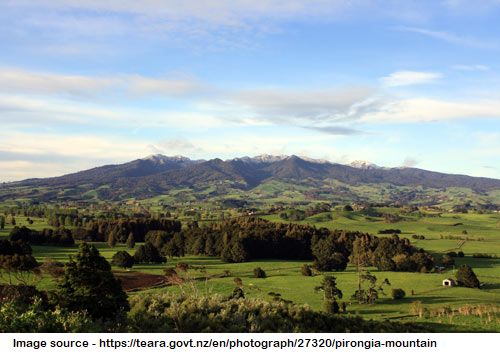
The traditional name for Pirongia is 'Pirongia te aroaro 0 Kahu' meaning 'the fragrant presence of Kahu' his wife. The full name of Karioi is Maunga-O-Karioi meaning to linger or loiter.
The Tainui people living close to Pirongia did not always live peaceful lives. In 1822, Nga Puhi warriors from Northland, armed with European muskets, journeyed south on a warpath.
Without access to such weapons, the occupants of Matakitaki Pa (located at the northern end of what is now Pirongia township) were forced to flee and almost 2000 lost their lives.
Plants
ALTITUDINAL CHANGES
As you climb Mt Pirongia you will notice the forest composition changes as you get higher.
Two broad forest types are present. The lower slopes of the mountain are covered in podocarp/broadleaved forest with scattered emergent rimu and rata over a canopy dominated by tawa.
The sub-canopy contains tree ferns such as wheki and silver fern, nikau palms and smaller individuals of the canopy trees. Other plants found in this vegetation zone include pigeonwood, hinau, pukatea, supplejack, mahoe, hangehange, kanono and toropapa.
As the altitude increases, these species are gradually replaced by hardy upland trees and shrubs including kamahi, tawari, Hall’s totara, tawheowheo, horopito and, near the summit, kaikawaka.
SPECIAL BOTANICAL FEATURES
Mt Pirongia is the largest area of native forest in the Waikato Basin and exhibits many interesting botanical features.
The Forest Park is of high botanical significance because at this latitude several plant species reach their northern or southern limits of distribution. For example, kauri, mairehau, tawari and taraire reach their southern limit near the park whilst kaikawaka is at its northern limit for the western side of the North Island.
Near the summit, rocky pinnacles support a few species such as snow totara and eyebright more commonly found in true sub alpine zones.
THREATENED PLANT SPECIES
Several threatened plants are found in the park including king fern, carmine rata and Thismia rodwayi.
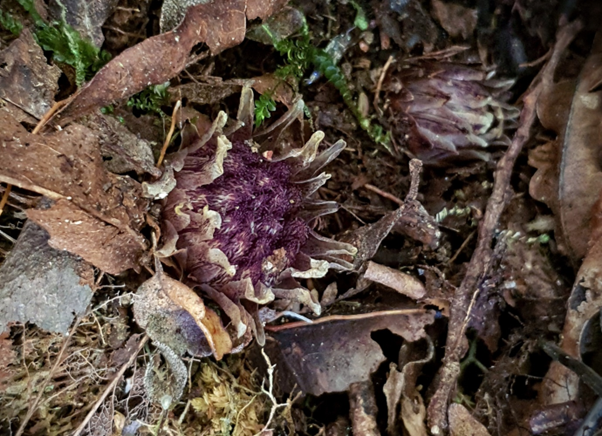
Dactylanthus taylorii (wood rose) is also present at higher altitudes and Pirongia is considered a national stronghold for this threatened species. The plants are caged to protect them from possums and rats. Our team of volunteers cage any new plants and repair any damaged ones.
ANIMALS
A great variety of native and introduced birds, pekapeka (bats) small lizards, eels, bullies (freshwater fish), trout and crayfish live in the park.
Since European settlement the numbers of native birds and insects has diminished due to changes in the forest caused by milling and the effect of introduced animal pests.
North Island saddleback, stitch-bird, North Island brown kiwi, kōkako, North Island weka and the North Island thrush have all disappeared from the park in the last 100 years.
While native species have declined, the number of introduced birds has increased.
BIRDS
Despite a reduction in native bird numbers in the park, it is still possible to see and hear many birds such as: grey warblers (riroriro), tomtits (miromiro), fantails (pirairaka), morepork owls (ruru), silver-eyes/wax-eyes, kingfishers (kōtare), Australasian harrier hawks (kāhu), whiteheads (pōpokatea), riflemen (tītipounamu) and the New Zealand pipit (pīhoihoi). In recent years (2022-2025) Kookako song has been heard by many people walking the different tracks on the maunga.
Kererū, tuī and bellbirds (korimako) are also present throughout the forest.
Kererū play a vital role in forest regeneration as their diet of fruits from a variety of shrubs and trees ensures the dispersal of seeds over a wide area. Trees such as tawa, miro and matai are almost totally dependent upon the kererū for seed dispersal.
New Zealand falcon (karearea) and kākā parrot are also occasional visitors to the mountain.
INSECTS
Although largely unnoticed, an abundance of insects inhabit the forest.
A scratch about amongst the leaf litter reveals all sorts of beetles and bugs. An especially good time to look for insects is at night when glowworms can be seen on damp banks.
Glowworms are most numerous from October to February. By torchlight you will see all sorts of beetles and moths feeding.
OTHER ANIMALS
Other animals found more easily at night include small native geckos, one of two families of lizard found in New Zealand.
Geckos feed mainly on insects and other small invertebrates although the forest gecko also feeds on nectar. Geckos have a flattened body with soft loose skin and a large blunt head.
Skinks are the other family of lizards found in New Zealand and one species of these is known to inhabit Pirongia Forest Park. Unlike the geckos, skinks have smooth, round bodies with a small pointed head.
These creatures are mostly nocturnal but are known to bask in the sun.
EUROPEAN SETTLEMENT
In 1770, Captain James Cook was the first European to record Pirongia. It did not take long before settlers arrived from the northern hemisphere, eager to make a new life for themselves in this land of plenty.
Conflicts with the original inhabitants were inevitable as each strove for dominance.
In the middle of the 18th century the Puniu River, south of Pirongia, represented a boundary between the lands to the north where Europeans were well established and Te Rohe Potae to the south, under Maori domain.
The garrison town of Alexandra was established to protect nervous settlers along this frontier. The town grew rapidly until the 1860s when the garrison was withdrawn and the promised railway was routed through Te Awamutu.
In 1896, the town's name was changed to Pirongia to prevent confusion with the newly prosperous gold-mining town of Alexandra in the South Island.
Farming soon became Pirongia's economic foundation. Land represented wealth and attention rapidly turned towards the potential of the mountain slopes.
Some forest was milled but much was simply felled and burned to clear the land as quickly as possible for farming.
Wholesale clearance was limited by the terrain and because the plains were far richer and easier to work.
The natural values of the forest are constantly under threat from a wide range of pest species, from small rodents to feral goats through to invasive plant pests.
Many of our native species, which evolved over the last 60 million years in the absence of ground-based mammalian predators, are poorly equipped to deal with these efficient killing machines and vigorous weeds.
LAND
in 1900 part of the mountain became Crown Land, with more land acquired over the following years.
In 1971, the land was designated a Forest Park under the New Zealand Forest Service and in 1987 management shifted to the Department of Conservation.
Sedimentary rocks underlie the western Waikato: ancient sandstones and argillite topped by younger marine sandstones, mudstone and limestone.
These layers are now eroded and have been moulded into gently rolling hills and valleys. Rising above this low-profile landscape are five dominant volcanoes running in a straight line from Karioi southwest to Tokanui.
Known as the Alexandra Volcanics, they lie along a line of weakness in the earth's crust.
FORMATION
Pirongia is the largest in the group and was built up mainly from thick layers of basalt lava.
Basalt lava is very fluid and it flowed swiftly from the vents near the summit to form the gentle slopes and long ridges around the mountain. Some flows travelled almost 20 kilometres to Kawhia Harbour.
Deposits of volcanic ash, tiny particles of molten rock fragmented by violent eruptions, are rare on Pirongia, suggesting most eruptions were relatively quiet. But quiet does not necessarily mean dull - spectacular fire-fountains of lava like those seen on Hawaii or Mt Etna, would have occurred.
The youngest lavas on the summit of Pirongia are about 1.6 million years old - about the same age as the oldest eruptions from the Rotorua /Taupo area.
Although the summit has been eroded and there is now no sign of the original crater, its maximum height was probably no more than 100-150 m above its current level. The oldest dated lavas on Pirongia, found on the southern side, are 2.7 million years old.
The Waikato region has also been influenced by more distant volcanic activity. Rivers carried vast amounts of material from the volcanoes of the central North Island to the alluvial plains around the Waikato – creating the fertile soils that typify the area.
Airborne ash from eruptions to the south also reached Pirongia, burying much of the forest on the lower slopes of the mountain.
WINDY AND WET
The park's climate is mild and wet, with humid summers and temperate winters. Average temperatures range from 18°C to 8°Cover the year. Light snow falls can occur on the summit in winter.
The topography of the area has a significant effect on the local climate. The mountains form a barrier to incoming fronts, causing these air masses to rise and in so doing, form clouds.
The clouds tend to develop continuously on the windward side of hills, but clear away on the lee side. This helps explain the difference in rainfall on the mountain and the surrounding farmland. Pirongia summit for instance, receives in excess of 2400 mm of rain per annum compared to the township of Pirongia which may only receive 1100 mm.
The mountains of Pirongia and Karioi also present a barrier to the prevailing westerly winds which can be particularly strong on Karioi. Just look at the wind-sculptured trees on the western flanks of the mountain if you are in doubt!
PESTS
Possum
Possums can, in high densities, kill large trees by heavy browsing, cause local extinction of threatened plants (such as mistletoe and Dactylanthus), and limit regrowth.
Possums also prey on bird eggs, chicks, and native insects. Possums have been controlled in the park since 1996. Numbers are currently low to moderate
Stoats, weasels, ferrets and cats
Stoats can kill birds up to twice their size and climb trees to reach nests.
Stoats and weasels also eat native insects. Ferrets prefer ground-dwelling birds like puukeko and fernbirds. Cats are also efficient killers of birds and insects.
Work to eradicate Pirongia’s mustelid predators began in 2019. DOC200 and DOC250 traps have been deployed to reduce pest numbers and protect our nesting native birds.
Goats, deer and pigs
Feral goats and deer browse on plants and in high numbers can remove the entire forest understory. Animal tracks can cause erosion, especially in wet weather.
Wild pigs eat native plants, causing more erosion through rooting, and will kill and eat ground-dwelling birds. The Department of Conservation has undertaken goat control in the park since the late 1990s and numbers are now low.
Deer and pig populations are also small.
BIRD PESTS
Magpies and mynahs are known to kill native birds and are aggressive and territorial.
Introduced parrots such as Eastern Rosellas, lorikeets and budgies compete with native birds for the same seed sources, as well as carrying potentially damaging diseases.
PLANT PESTS
Plant Pests are found throughout the forest especially on the fringes.
Climbing vines such as Japanese honeysuckle grow quickly, smothering tall trees. Other weeds such as tradescantia form dense mats cutting out all light and stopping the growth of native seedlings.
Some introduced trees, like pines and privet, grow vigorously and can change the forest makeup. Gorse, pampas and buddleia quickly invade eroded areas and slips, preventing native species from re-establishing.
OTHER PESTS
Other threats to forest health include fire and livestock encroachment from surrounding land.
MONITORING AND CONTROL
Plant and animal pests can be monitored to determine population levels and the need for further control.
Forest ecosystems can be checked to determine what impact pests are having. Bird species can be monitored by individually banding birds, videoing nest sites, or listening for native birdcalls.
Even insect populations can be assessed using pitfall traps that capture live insects for counting then release.
Pests can be controlled in a number of ways. For animal pests methods such as poisoning, shooting, trapping and fencing are used. Plant pests can be controlled by manual removal such as digging, cutting or felling, or by chemical removal using herbicides.
New Zealand leads the way in the development of monitoring methods and control techniques ensuring our native ecosystems are maintained for all future generations.